


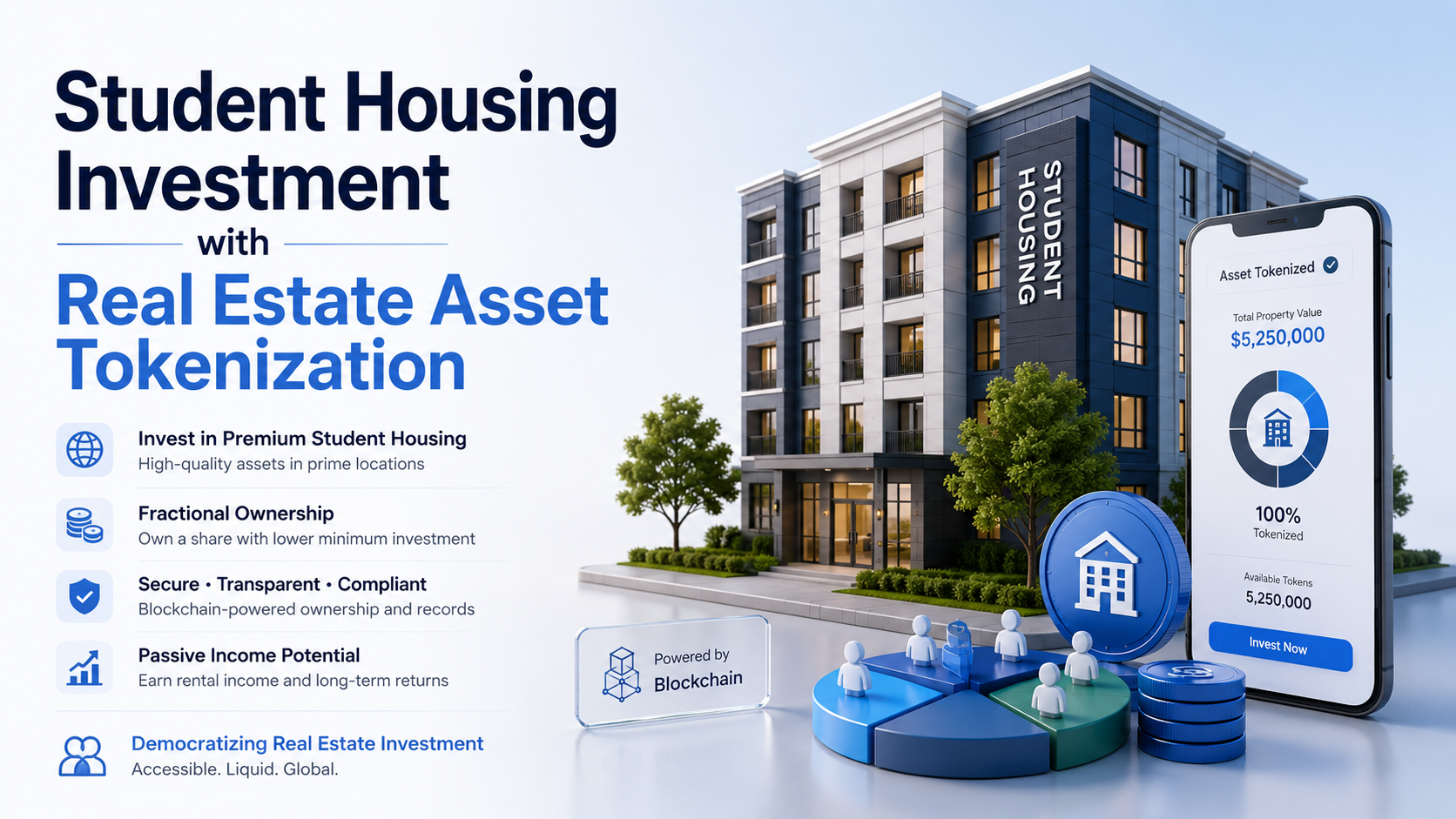
Student housing has become one of the most reliable real estate investment categories because universities continue to attract domestic and international students every year. Demand for accommodation remains steady in many education hubs, making student housing an attractive option for investors looking for long-term rental income. However, purchasing an entire student housing property often requires significant capital, making participation difficult for many individual investors.
This is where real estate asset tokenization offers a practical investment approach. By converting ownership rights into digital tokens on a blockchain network, property owners can divide a single student housing asset into smaller investment units. Investors can purchase these digital shares instead of buying an entire property. This method gives access to a wider investment audience while allowing property owners to reach potential investors from different regions.
As blockchain adoption grows across financial and property markets, Real Estate Tokenization is becoming an important topic among developers, property managers, institutional investors, and startup founders. Student housing is particularly suitable because of its recurring rental income, long occupancy cycles, and growing demand near colleges and universities. This article explains how student housing investment works with tokenization, its advantages, development process, business considerations, and future opportunities.
Understanding Student Housing Investment
Student housing refers to residential properties designed specifically for university and college students. These properties include dormitories, private apartments, shared accommodation, purpose-built student housing, and mixed residential communities located near educational institutions.
Unlike many traditional residential properties, student housing often benefits from recurring demand. Every academic year introduces new tenants, while graduating students are replaced by incoming students. This ongoing cycle creates relatively consistent occupancy when properties are located in suitable educational districts.
Property owners generally generate revenue through monthly rent, additional amenities, parking, laundry facilities, and maintenance services. Investors view this sector as an attractive asset because rental demand is linked to educational enrollment rather than short-term market conditions alone.
What Is Real Estate Asset Tokenization?
Real estate asset tokenization is the process of converting ownership interests in physical property into blockchain-based digital tokens. Each token represents a defined ownership portion of the asset and may provide rights related to rental income, appreciation, or profit distribution depending on the investment structure.
Instead of requiring a single investor to purchase an entire student accommodation building, ownership can be divided among hundreds or even thousands of participants. Investors purchase tokens representing their respective shares.
Every ownership record, transaction, and distribution can be recorded on blockchain infrastructure, creating an organized digital record of investment activity. Real Estate Tokenization gives property businesses another way to attract investment while offering investors additional property participation options.
Why Student Housing Is Suitable for Tokenization
Student housing possesses characteristics that align well with digital ownership models.
Predictable Rental Income
Universities usually experience regular student enrollment throughout the year. As long as accommodation remains competitive and well maintained, rental occupancy may remain relatively stable compared to certain commercial properties.
Regular rental collections simplify income distribution among token holders according to predefined ownership percentages.
Fractional Investment Opportunities
Many investors cannot afford large residential buildings. Tokenization divides ownership into affordable units, making student housing investment accessible to individuals with smaller investment budgets.
Fractional ownership also allows investors to diversify across multiple properties instead of placing all capital into one building.
International Investor Participation
Universities attract students from around the world. Likewise, tokenized student housing may interest investors from multiple countries depending on applicable regulations.
Digital investment processes simplify participation without requiring every investor to complete traditional property purchase procedures.
Portfolio Diversification
Institutional investors and retail investors often seek different real estate categories to balance investment portfolios. Student housing introduces another asset class alongside offices, apartments, hotels, warehouses, and retail properties.
How Real Estate Tokenization Works for Student Housing
A structured process is followed before digital tokens become available for investors.
Property Selection
The first step involves identifying a suitable student housing property. Factors such as occupancy rates, rental history, location, maintenance condition, and projected returns are evaluated.
Legal Structuring
Property ownership is organized according to local regulations. Investment rights, ownership percentages, income distribution methods, and investor eligibility are documented before token issuance.
Asset Valuation
Professional valuation determines the market value of the student housing property. This valuation helps determine token pricing and the number of digital ownership units.
Token Creation
Blockchain technology creates digital tokens representing ownership interests. Each token corresponds to a defined percentage of the property.
This stage often involves real estate tokenization development using blockchain protocols and smart contracts.
Investor Onboarding
Interested investors complete identity verification, compliance checks, and documentation before purchasing tokens.
Rental Income Distribution
Rental income generated by student tenants can be distributed according to token ownership after operational expenses and management costs are considered.
Benefits for Property Owners
Property owners receive several business advantages through tokenized investment models.
One significant benefit is broader investor participation. Rather than searching for one institutional buyer, property owners can raise capital from numerous qualified investors.
Another advantage is improved fundraising flexibility. Owners may tokenize one building while continuing to manage operations without selling complete ownership.
Tokenization can also support future expansion. Property operators may raise additional capital for renovations, new student housing projects, or property acquisitions by issuing new investment opportunities under applicable regulations.
Benefits for Investors
Investors also receive several practical advantages.
Lower investment requirements make student housing accessible to individuals who may not otherwise participate in commercial property markets.
Portfolio diversification becomes easier since investors may purchase smaller ownership portions across multiple properties.
Digital ownership records simplify investment tracking while blockchain records maintain transaction history.
Rental income distribution provides another reason many investors consider student housing an attractive long-term asset category.
Technology Behind Student Housing Tokenization
Blockchain technology forms the digital foundation for tokenized property investments.
Smart contracts automate investment rules, ownership transfers, income calculations, and compliance procedures according to predefined conditions.
Digital wallets allow investors to securely hold ownership tokens.
Identity verification systems assist with investor registration and compliance requirements.
Property management systems may integrate with blockchain platforms to synchronize rental collections, maintenance records, occupancy information, and financial reporting.
Real Estate Tokenization Platform Development combines these technologies into one investment platform that manages property operations alongside investor participation.
Compliance Considerations
Legal compliance remains one of the most important aspects of any tokenized property project.
Different countries classify tokenized real estate investments under different financial regulations. Property operators should comply with securities laws, investor verification requirements, taxation rules, and reporting obligations.
Professional legal advisors work alongside blockchain developers throughout project planning.
A Real Estate Tokenization company generally collaborates with legal specialists, compliance consultants, and property experts before launching investment platforms.
Choosing the Right Development Partner
Developing a student housing tokenization platform requires experience across multiple disciplines.
A reliable Real Estate Tokenization Development company understands blockchain architecture, smart contract development, digital wallet integration, investor onboarding, security testing, and regulatory requirements.
Businesses should evaluate previous project experience, technology expertise, maintenance support, blockchain selection, platform security, and post-launch assistance before selecting a development partner.
Real Estate Tokenization Development Services generally include planning, blockchain integration, smart contract programming, dashboard development, security auditing, testing, deployment, and technical maintenance.
Features Expected in Student Housing Tokenization Platforms
Modern investment platforms typically include several practical features.
Investor Dashboard
Investors can monitor token holdings, rental income, transaction history, and portfolio performance through a centralized dashboard.
Property Information
Detailed property descriptions, valuation reports, occupancy statistics, financial summaries, and legal documentation help investors make informed decisions.
Digital Wallet Integration
Wallet connectivity allows investors to receive, hold, and transfer ownership tokens according to platform policies.
Income Distribution Management
Automated payment systems simplify rental income allocation based on ownership percentages.
Compliance Module
Identity verification, investor eligibility checks, document management, and reporting functions support regulatory compliance.
Administration Panel
Platform administrators manage property listings, investor records, financial reports, maintenance updates, and token issuance from one interface.
Challenges to Consider
Although tokenization presents many opportunities, businesses should prepare for practical challenges.
Regulatory requirements continue to evolve across different jurisdictions.
Investor education remains necessary because many property investors are still unfamiliar with blockchain investments.
Cybersecurity requires ongoing attention through audits, software updates, and infrastructure monitoring.
Property management quality continues to influence investment performance regardless of blockchain implementation.
Liquidity may vary depending on secondary marketplace availability and applicable regulations.
Addressing these factors during planning contributes to better long-term platform operations.
Future Outlook for Student Housing Tokenization
Student housing demand is expected to continue growing in many countries because higher education remains an important priority for millions of students.
At the same time, blockchain adoption continues expanding across financial services and digital investment ecosystems. These developments create opportunities for property companies seeking new fundraising approaches.
Institutional investors, universities, private accommodation operators, and real estate investment firms may increasingly evaluate tokenized ownership structures as digital investment markets mature.
As regulations become more defined and investor familiarity grows, student housing may become one of the property categories frequently associated with blockchain-based ownership models.
Conclusion
Student housing represents a real estate sector supported by recurring rental demand and long-term investment interest. Combining this market with real estate asset tokenization allows property owners to divide ownership into digital investment units while providing investors with opportunities to participate through fractional ownership. Businesses planning to enter this market require careful legal planning, reliable blockchain infrastructure, and experienced development support. Blockchain App Factory provides Real Estate Tokenization Services that help businesses develop secure student housing investment platforms through Real Estate Tokenization Development Services, real estate tokenization development, and Real Estate Tokenization Platform Development while supporting projects from planning to deployment.
Frequently Asked Questions
1. What is student housing tokenization?
Student housing tokenization is the process of converting ownership rights of student accommodation into blockchain-based digital tokens that represent fractional ownership of the property.
2. Why is student housing suitable for Real Estate Tokenization?
Student housing generally benefits from recurring rental demand, making it an attractive asset for fractional ownership and long-term investment participation.
3. Who can invest in tokenized student housing?
Eligibility depends on local regulations and platform policies. Investors usually complete identity verification and compliance procedures before purchasing property tokens.
4. What does a Real Estate Tokenization company provide?
A Real Estate Tokenization company offers blockchain development, smart contract creation, compliance integration, investor management systems, security testing, platform deployment, and maintenance services.
5. What is included in Real Estate Tokenization Development Services?
These services typically include platform planning, blockchain integration, smart contract programming, investor dashboards, wallet integration, compliance modules, testing, deployment, and technical support.
6. How does Real Estate Tokenization Platform Development support property businesses?
Real Estate Tokenization Platform Development helps property businesses digitize ownership, manage investors, distribute rental income, maintain digital records, and support tokenized property offerings through blockchain technology.




 English
 Indonesia
 Arabic
 French
 Spanish
 Portuguese
 Deutsch
 Turkish
 Dutch
Dutch
 Russian
 Romaian
 Portuguese (Brazil)
 Greek
Greek